


The Fools' Fountain in Zell am Harmersbach stands at the corner of Hauptstraße and Kanzleistraße and is dedicated to the fool characters of the Zeller Fasend carnival.
The scene shows the tall, proud playing card fool who has swung himself up onto the fountain post and is pinching the snail shell fool sitting on the fountain pipe in the back with his scissors. In the foreground, the Bändelenarro rises from the depths of the earth with the Saubloder on the edge of the fountain. The figure of the Welschkornnarro was added to the Fools' Fountain in 2004.
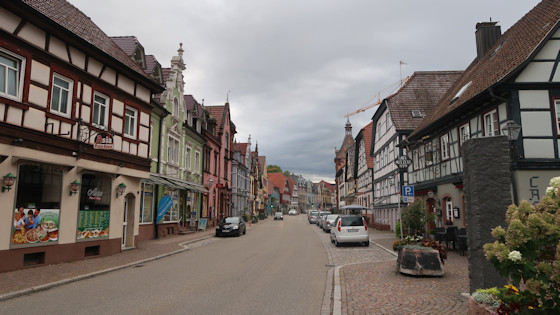
In 1330, Zell was granted town privileges by Emperor Ludwig and became a free imperial city. The defensive wall was built by 1363. The town fires of 1899 and 1904 had a decisive influence on the town's appearance today: afterwards, numerous houses were built in the historicist and Art Nouveau styles. Their ornamentation and playful façades, together with the medieval half-timbered houses on the main street, give the town its unique character.

The remains of the city wall, Storchen Tower and Hirsch Tower are therefore among the oldest structures in the city.

After a short climb on the Way of St. James, this view of Zell opens up.

The trail leads along side roads along the Nordrach towards the village of Nordrach through the districts of Lindach and Allmend.

The Maile-Giessler Mill
The mill was built in 1881 and was initially powered by a wooden water wheel, which was replaced by an iron one in 1919. It remained in operation until 1948. It was renovated by the Black Forest Association in 1982.
The church in Nordrach can be seen in the background.

The richly structured neo-Gothic parish church of St. Ulrich rises like a small cathedral with its 63-metre-high tower. In the left aisle, the vaulted baptistery houses the oldest part of the church: the baptismal font from 1618, which dates back to the old church. Six red sandstone columns divide the 40.8-metre-long, 17.2-metre-wide and 17-metre-high room. The nine windows in each of the side aisles and the eight windows in the upper part of the nave let in enough light, even though they are all painted. They depict scenes from the lives of the ‘14 Holy Helpers’. The name of the donor is also immortalised on most of the windows.

The high altar, carved and painted in 1905, illustrates the work of redemption with scenes from the ‘Sorrowful Rosary’.

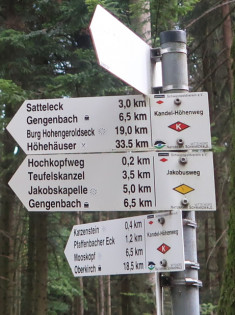
After a long climb, we stopped for lunch at this little hut.
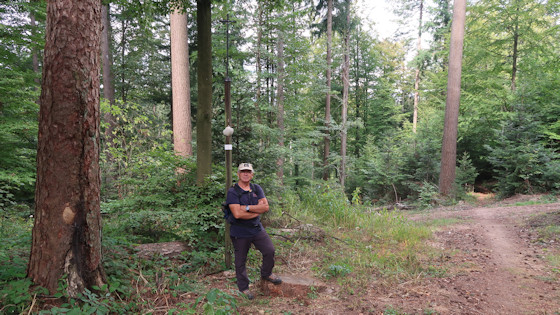
Our tour guide Gerhard at the Cross of St James

Once you reach the top, called Teufelskanzel, you can see all the way to Strasbourg.
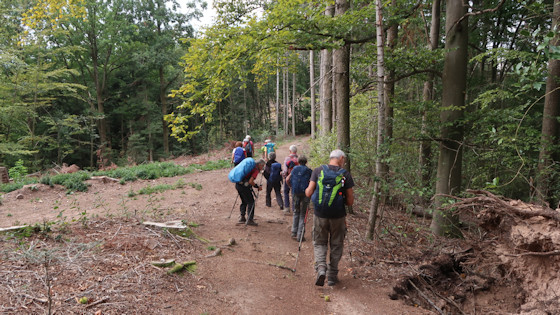
It's downhill again.
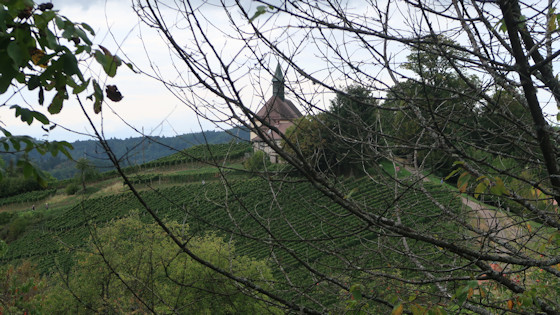
St. James' Chapel,
a landmark of the town of Gengenbach, sits enthroned on the ‘Gengenbacher Bergle’ above the old town, surrounded by vineyards.
This hilltop, with its sweeping views of the Rhine Valley, was once a Roman place of worship, as evidenced by numerous coin finds. For a long time, the chapel was a stop on the great pilgrimages to Santiago de Compostela in Spain. The current building dates from 1681. Special features include the stone pulpit and the neighbouring Holy Sepulchre Chapel. The seven paintings by Ruth Schaumann, depicting the Beatitudes from the Sermon on the Mount, were donated recently.

In a document from 1289, it is referred to as Capella sancti Jacobi in Monte Castellberg. The St. James Chapel as it stands today dates back to 1682.
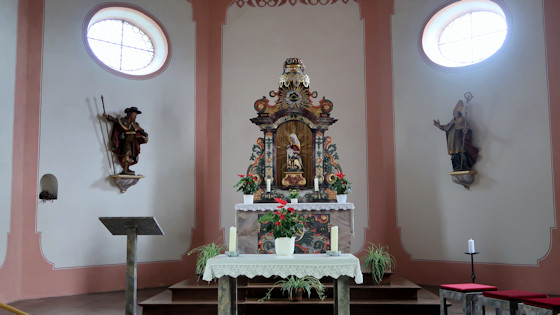
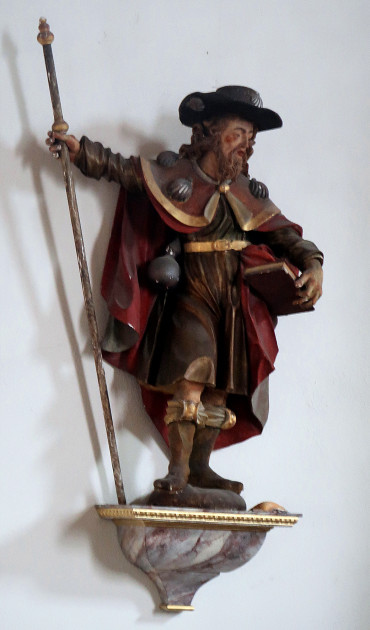
In the choir, on the left stands the Baroque statue of James as a pilgrim and on the right Bishop Apollinaris. Apollinaris is considered the founder of the Christian community of Ravenna, was its bishop and died a martyr. According to legend, he lived around the year 75; he was sent to Ravenna by Peter himself as a messenger of the faith and served as bishop there for 20 years. During an attack by non-Christians, he was mistreated and killed in agony.
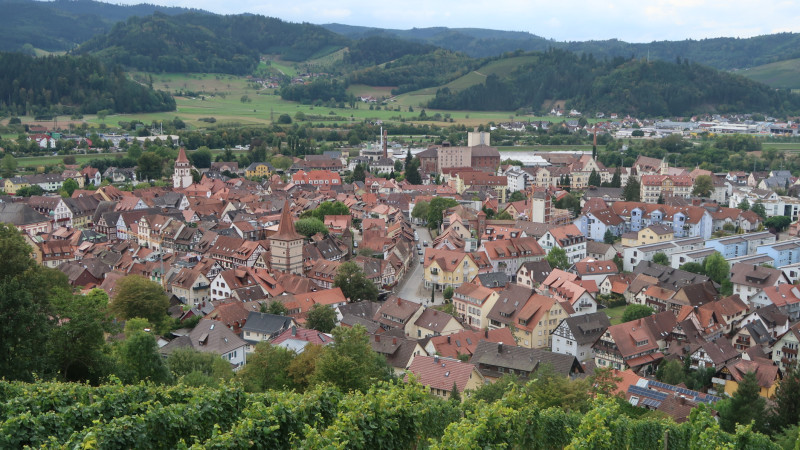
On the descent from St James' Chapel, you have a wonderful view of Gengenbach.

Haslach - Zell am Harmersbach


Gengenbach
