


Right next to Loßburg railway station, this sign points to the Kinzigtal Jakobusweg trail. It is approximately 2 km to the first houses in Loßburg.
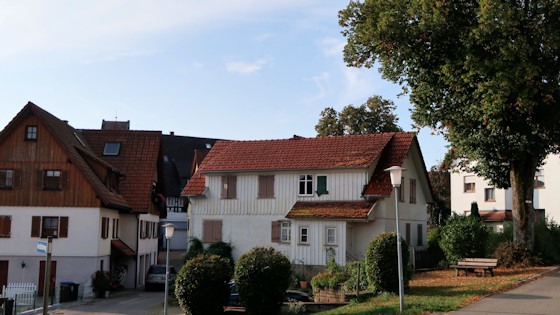
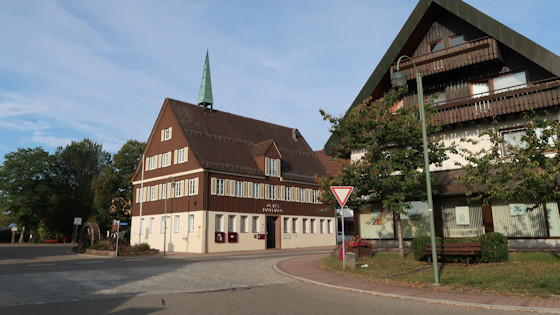
Loßburg Town Hall
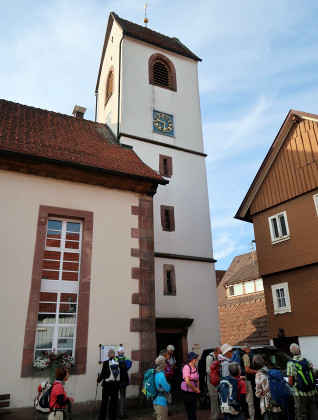
St. James' Church in Loßburg,
now a community centre. The foundation walls of the church tower date back to the 13th/14th century. St. James' Church is first mentioned in a document from 1409. In it, a certain Hans von Brandeck promises to donate 27 hellers annually from his estate in Schömberg (near Loßburg) to ‘dear Saint James of Loßburg’ for the salvation of his soul. But it was not until 1463 that Loßburg received permission from the Diocese of Constance to hold regular Masses in the village. St. James' Church was rebuilt in 1499. The parish joined the Reformation, i.e. the Lutheran denomination, in 1555. The church was demolished in 1833. A new church was built on the same site. Today, it is used for secular purposes and serves as a community centre. (The area up to Schenkenzell, today's stage destination, historically belonged to the Kingdom of Württemberg, which was Lutheran. The Grand Duchy of Baden, on the other hand, has always been Catholic.)
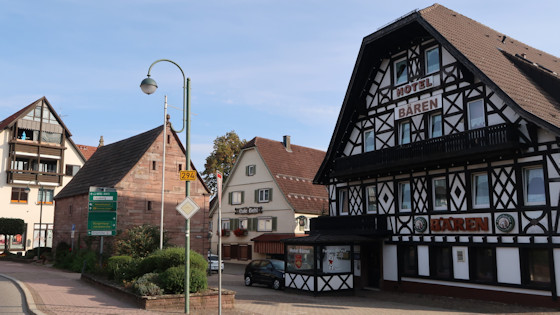
A striking half-timbered building, the Hotel Bären, built in 1623.
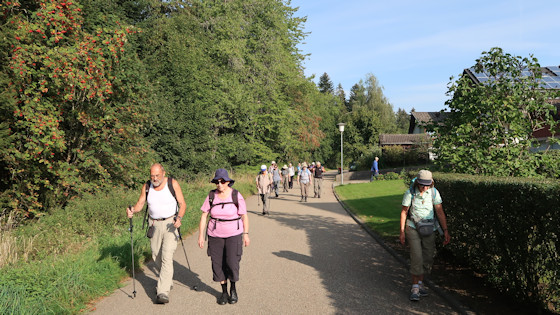
We leave Loßburg...
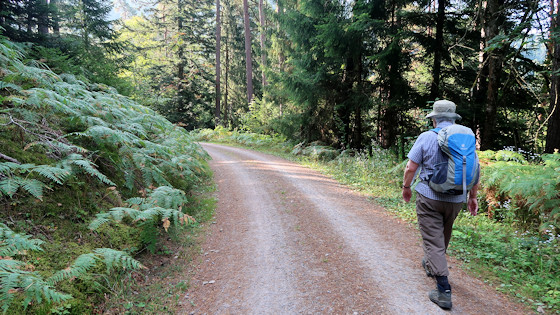
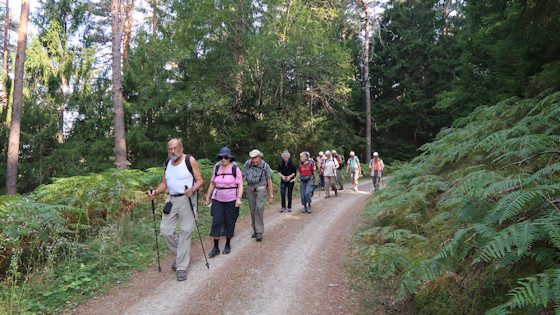
... and hike into the Black Forest.
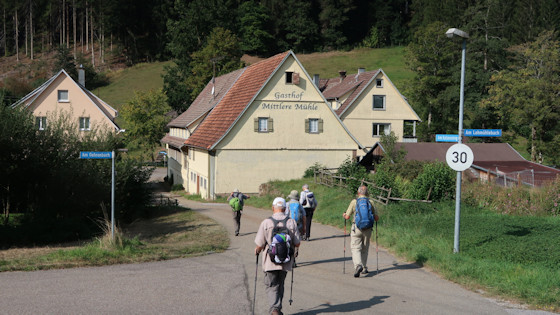
Gasthof Mittlere Mühle (Middle Mill Inn)

Along the way, we encounter many beautiful farms. Here are two examples:
The Metzgersbauernhof
The farm's name was given by its owner Hans Beck in 1701, who was a butcher and farmer. In 1983, the old Metzgersbauernhof burned to the ground. The newly built residential and farm buildings now house several holiday apartments. The farm has its own drinking water supply, its own biological sewage treatment plant and a solar power system.
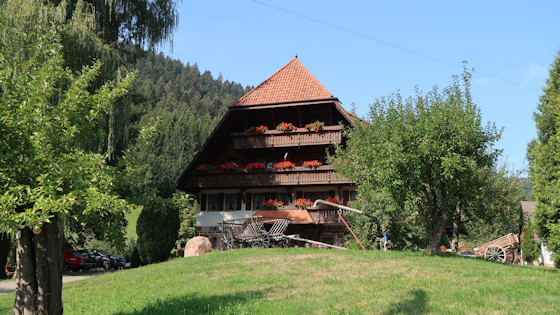
The Vogtsmichelhof
The Vogtsmichelhof was first mentioned in documents in 1459. In 1749, Hans-Jakob Adrion was the first bailiff at the farm.
The farm burned down completely several times. In 1991, the farm was ready to be occupied again. Cattle and pig farming make up the agricultural part of the business. The forestry part is partly financed by the sale of wood, but also by the fact that the farm is largely self-sufficient in wood energy. The farm has its own spring.
There are also various tourist attractions and schnapps from the farm's own distillery.
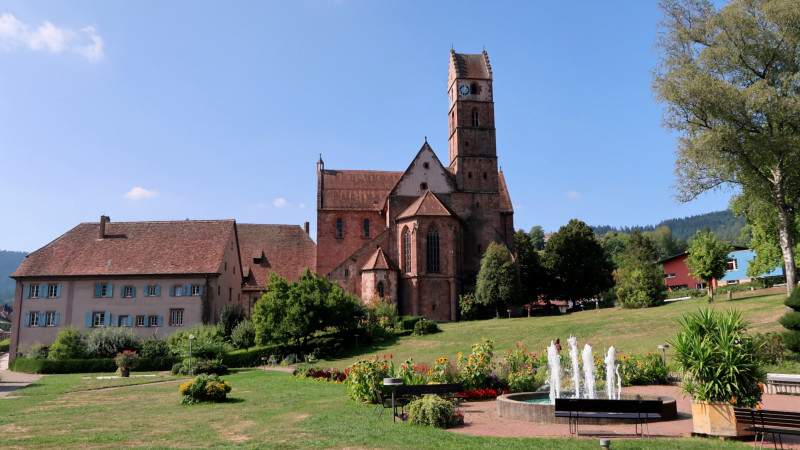
Alpirsbach
The name Alpirsbach is probably associated with Adalbert von Zollern, one of the three founders of the monastery.
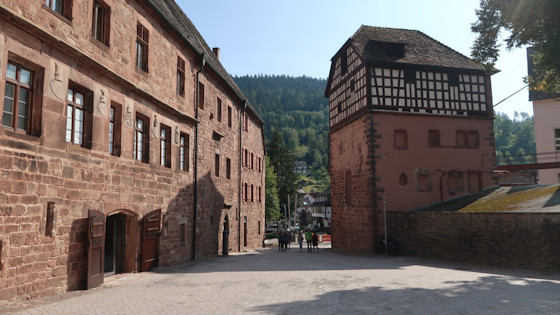
Former Benedictine Abbey
The most significant historical building in Alpirsbach is the former Benedictine Abbey. Founded by three regional nobles more than 900 years ago, the abbey was settled by monks from St. Blasien Monastery. It was consecrated by the Bishop of Constance in 1095. The Romanesque monastery complex is built of red sandstone. The abbey is one of the 11th-century reform monasteries in south-western Germany. These date back to Hirsau Abbey (near Calw in the north-east of the Black Forest). The building is an impressive example of Cluniac reform architecture. The monastery church is a columned basilica. The Gothic cloister (1483), the chapter house, the convent hall and the dormitory, the monks' sleeping quarters, are still preserved from the former monastery, which was dissolved during the Reformation. The former refectory (dining hall) now houses the Catholic Church of St. Benedict, while the Protestant congregation holds its services in the monastery church. In the cloister, there is a keystone with a depiction of St. James. It is located at the top of the vaulted ceiling in front of the room of silence. Concerts are often held in the cloister.
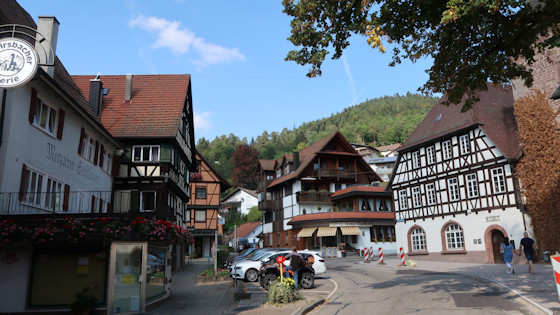
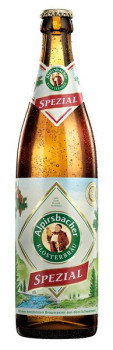
Alpirsbacher Klosterbräu produces and distributes various beers.
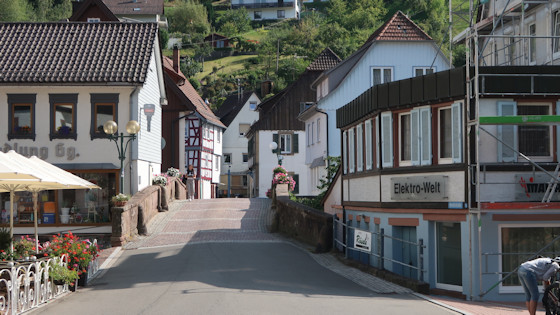
Bridge over the Kinzig river in Alpirsbach.
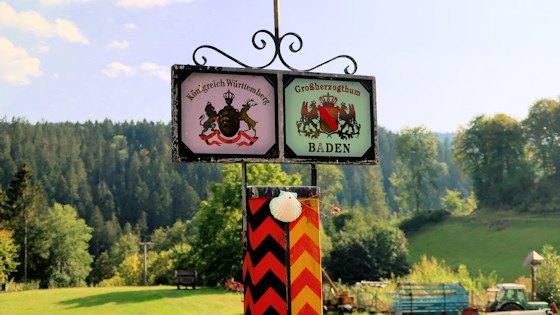
We pass the former border between the Kingdom of Württemberg and the Grand Duchy of Baden.

wayside cross
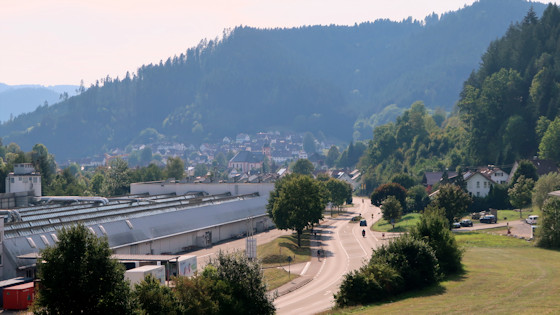
First view of Schenkenzell. The landmark is the ruins of Schenkenburg Castle (not pictured). It is not located directly on the trail. Schenkenburg Castle was built between 1220 and 1250, probably by the Schenken von Zell family, after whom the village is named. They were ministerials of the Counts of Freiburg, responsible for mining in the area.
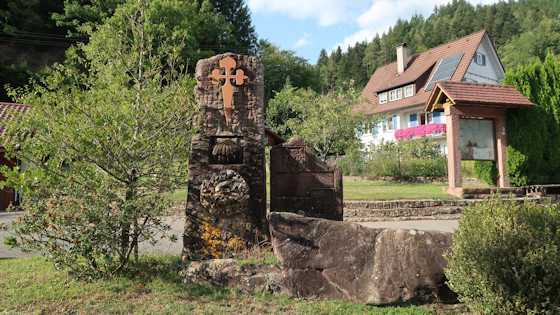
Pilgrim monument outside Schenkenzell.
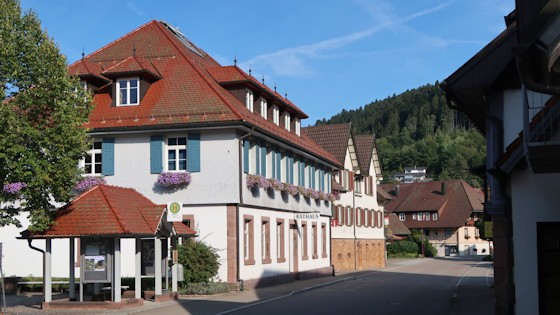
Schenkenzell Town Hall.
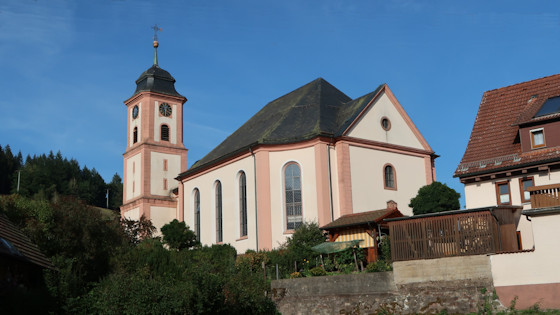
St Ulrich's Church
The church consists of a Baroque choir and tower and a nave built after the Second World War.
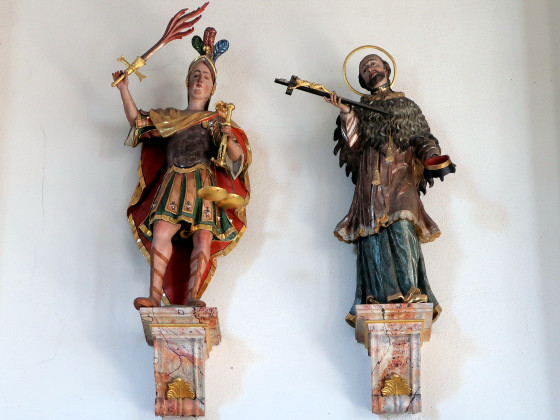
In the choir, we see St. Michael weighing souls with a flaming sword and scales on the left. To his right is St. John of Nepomuk, patron saint of the seal of confession.


Schenkenzell - Wolfach
